Justice for Ibrahima! Demonstration zum Prozessende in Duisburg
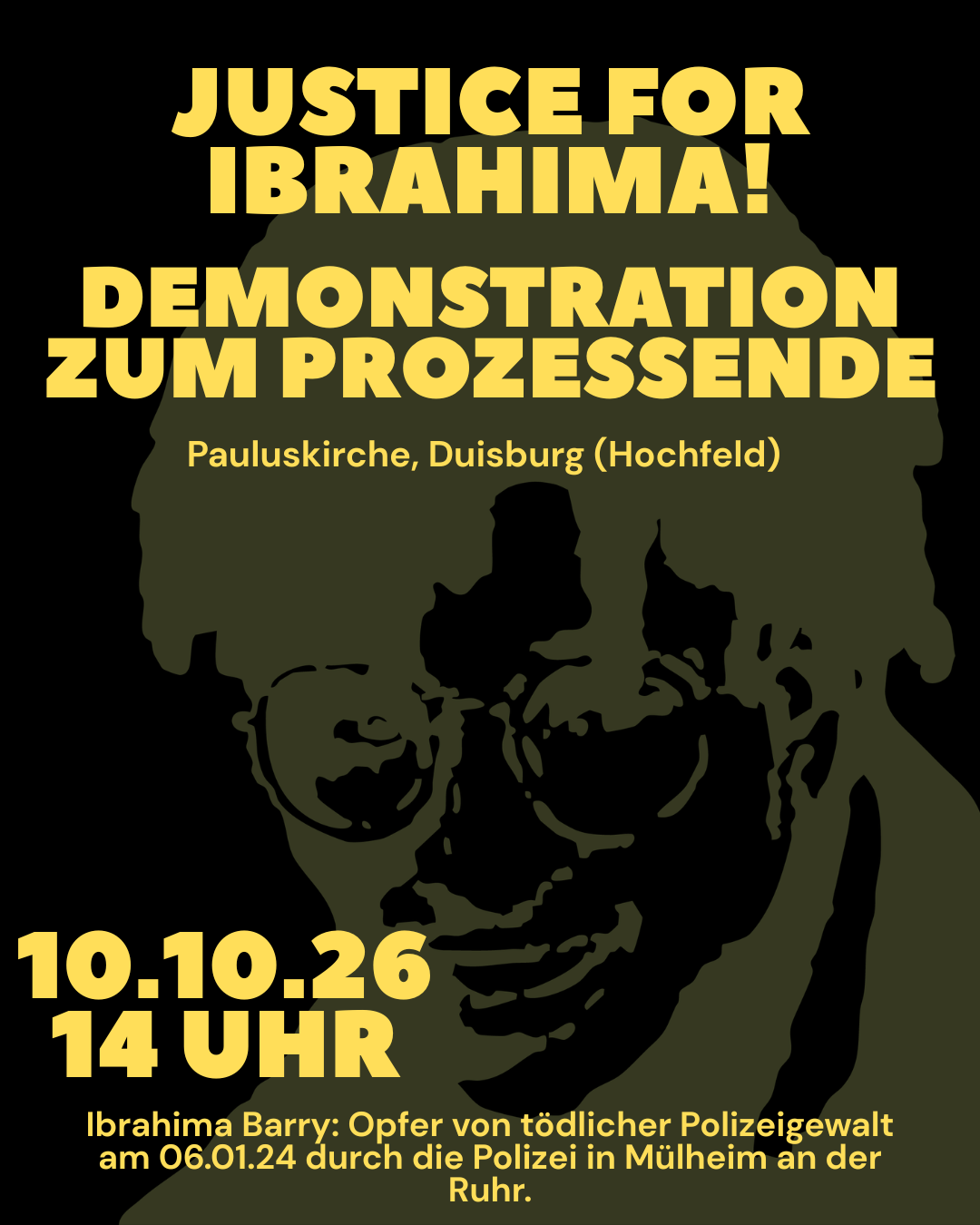
English below
Version française ci-dessous
Aufruf zur Demonstration
Alle Polizist*innen wurden freigesprochen. Für uns ändert sich nichts. Wir wissen, was sie getan haben. Es bleibt sichtbar.
Am Mittwoch, den 30.09., hat das Landgericht Duisburg alle Polizist*innen, die Ibrahima getötet haben, freigesprochen. Ein Freispruch, der die Familie Barry und ihren Wunsch nach Wahrheit und Gerechtigkeit tief verletzt.
Drei Monate hat der Prozess gedauert. Der Prozess gegen die 9 Polizist*innen, die an dem Einsatz beteiligt waren, durch den Ibrahima am 06.01.24 in Mülheim an der Ruhr (NRW) getötet wurde. Die Polizist*innen wurden wegen gefährlicher Körperverletzung angeklagt und nicht wegen dem Tod von Ibrahima. Das Gericht hat mit diesem Freispruch gesagt, dass die Polizist*innen Ibrahima nicht gefährlich verletzt hätten, dass Ibrahima noch nicht einmal Schmerzen empfunden habe. Letztendlich hat das Gericht gesagt, dass die Polizei alles darf, wenn es um einen geflüchteten Schwarzen Jugendlichen geht. Es sei alles "zulässig" gewesen. Es ist ein schreckliches Signal. Es betrifft alle in diesem Land, wenn Gerichte sagen, es gebe überhaupt keine Grenzen für das Handeln des Gewaltmonopols.
Während des ganzen Prozesses gab es keinen ernsthaften Versuch von Seiten der Ermittlungsbehörden, der Staatsanwaltschaft oder dem Gericht, den Tod von Ibrahima aufzuklären. Die Bodycams wurden nicht richtig ausgewertet. Ibrahimas Aussagen wurden nicht transkribiert und übersetzt. Seine letzten Worte auf Fula und Deutsch waren "Ihr bringt mich um" und "Ihr habt mich umgebracht".
Unabhängige Gutachten wurden abgelehnt. Gutachten, aus denen sich klarerweise ergibt, dass Ibrahima durch den Polizeieinsatz getötet wurde. Ein Tod, der hätte vermieden werden können. Ein Tod, der von der Polizei an dem Tag in Kauf genommen wurde.
Jetzt sagt das Gericht, dass Ibrahima zufälligerweise vor dem Einsatz schon einen Herzinfarkt gehabt habe, von dem er selbst nichts gemerkt habe. Das sagt schon alles. Das Gericht sagt, dass Menschen wie Ibrahima, schwarze Geflüchtete, schon lange für Instanzen wie die Polizei tot sind, noch bevor es einen Einsatz gibt. Deswegen haben das Gericht, die Staatsanwaltschaft und die Verteidigung der Polizist*innen darüber gesprochen, dass Ibrahima es verdient hätte zu sterben. Im Prozess wurde so gesprochen, als wäre Ibrahima angeklagt und nicht die neun Polizist*innen.
Es gibt keine perfekten Opfer von Polizeigewalt. Es wurde im Gericht mehrmals klargestellt, dass die Polizei noch nicht mal nach ihren eigenen Regeln und Ausbildungen gehandelt hat. Das heißt: es gibt keine Regeln oder Gesetze, die für sie gelten. Ihr Verhalten kann immer entschuldigt werden, kann immer für Gerichte verständlich sein.
Ibrahimas Familie wünscht sich Anerkennung und Verantwortungsübernahme. Sie wünschen sich, dass keine andere Familie das erleben muss, was sie seit Januar 2024 erleben. Dafür sind sie nach Deutschland gekommen. Sie hatten große Erwartungen, dass sie durch das Gericht endlich erfahren, was ihrem Sohn und Bruder passierten ist. Dass die Polizist*innen endlich sagen würden, dass es ihnen leid tut, was sie Ibrahima angetan haben. Nicht nur wurden sie jeden Tag vor Gericht enttäuscht. Sie mussten im Gericht auch erleben, wie nur entmenschlichende Geschichten über ihren Sohn und Bruder erzählt wurden. Wie Ibrahima bereits in seinem Leben so viel Entmenschlichung und Rassismus erlebt hat. Wie er bis zu seinem Tod weiter so behandelt wurde.
Dardaye Barry, Ibrahimas Schwester, wünscht sich nur, dass ihrem Bruder die Würde zurückgegeben wird, die ihm genommen wurde. Wir werden deswegen weiterhin an Ibrahima gedenken und für ihn kämpfen.
Es bleibt uns allen eine Aufgabe dafür zu sorgen, dass die Polizei nicht nochmal einen Schwarzen Jugendlichen, einen Migranten, ein geflüchteter Mensch, einen Menschen in einer psychischen Ausnahmesituation kontrolliert, verprügelt, tasert, in Bauchlage fixiert und tötet. Es ist unsere Aufgabe dafür zu sorgen, dass die Polizei mit Konsequenzen rechnen muss, wenn sie tötet. Gerichte wollen das verhindern. Es bleibt unsere Aufgabe dafür zu sorgen, dass anerkannt wird, dass die Polizei tötet.
Es ist nicht das erste Mal, dass diese Konsequenzlosigkeit, die wir in diesem Gerichtsprozess gegen Polizist*innen beobachten, stattfindet. Wir denken an Sidy und Lasana, die Brüder von Mouhamed Lamine Dramé und an Mamadou, den Bruder von Oury Jalloh. Wir gedenken an Mariama Djombo Diallo, der Mutter von Oury Jalloh, die nach dem Prozess gegen die Polizist*innen und der daraus folgenden Konsequenzlosigkeit und mangelnden Anerkennung an Herzversagen gestorben ist.
Die Tötung einer Person durch die Polizei zerstört nicht nur das Leben von denjenigen, die sie tötet. Sie macht eine ganze Familie und einen Kreis von Freund*innen auch zu Opfern.
Die Familie Barry hat etwas erlebt, was sie, wie sie sagen, niemandem anderen wünschen. Sie haben aber auch ihre Trauer in die Kraft transformiert, um für Ibrahima zu kämpfen. In den letzten Monaten haben sie uns gezeigt, was es heißt, darauf zu bestehen gehört zu werden, für Gerechtigkeit zu kämpfen und auf dem Leben zu beharren.
Mit dieser Kraft wollen wir am 10.10. auf die Straße für Ibrahima gehen. Damit seine Geschichte überall gehört wird. Damit er nie vergessen wird. Damit wir alle zusammen dafür sorgen, dass keine anderer Schwarzer Junge, kein Mensch in einer psychischen Ausnahmesituation ohne jegliche Unterstützung alleine gelassen wird. Damit die Geschichte von Ibrahima sich nicht nochmal wiederholt.
Justice for Ibrahima!
Kein Vergeben. Kein Vergessen.
Call for a Demonstration
October 10, 2026, 2:00 p.m.
Pauluskirsche, Duisburg (Hochfeld)
All the police officers were acquitted. Nothing has changed for us. We know what they did. It remains visible.
On Wednesday, September 30, the Duisburg Regional Court acquitted all the police officers who killed Ibrahima. This acquittal deeply wounds the Barry family and their desire for truth and justice.
The trial lasted three months. It was the trial of the nine police officers involved in the operation during which Ibrahima was killed on January 6, 24, in Mülheim an der Ruhr (North Rhine-Westphalia). The police officers were charged with aggravated assault and not with causing Ibrahima’s death. With this acquittal, the court has effectively stated that the police officers did not inflict dangerous injuries on Ibrahima, and that Ibrahima did not even feel any pain. Ultimately, the court has said that the police can do whatever they want when it comes to Black refugees. Everything was deemed “permissible.” This sends a terrible message. It affects everyone in this country when courts say there are absolutely no limits to the actions of the monopoly of violence.
Throughout the entire process, there was no serious attempt on the part of the investigating authorities, the prosecutor’s office, or the court to clarify the circumstances of Ibrahima’s death. The bodycam footage was not properly analyzed. Ibrahima’s statements were not transcribed or translated. His last words, spoken in Fula and German, were “You’re killing me” and “You’ve killed me.”
Independent expert reports were rejected—reports that clearly show Ibrahima was killed as a result of the police operation. A death that could have been prevented. A death that the police accepted as a risk that day.
Now the court claims that, coincidentally, Ibrahima had already suffered a heart attack before the operation, one of which he himself was unaware. That says it all. The court is saying that people like Ibrahima—Black refugees—have long been considered dead by institutions like the police, even before any operation takes place. That is why the court, the prosecution, and the defense attorneys for the police officers all spoke as if Ibrahima deserved to die. During the trial, they spoke as if Ibrahima were the accused, not the nine police officers.
There are no perfect victims of police violence. It was made clear in court on several occasions that the police did not even act in accordance with their own rules and training. This means there are no rules or laws that apply to them. Their behavior can always be excused and can always be understood by the courts.
Ibrahima’s family wants recognition and accountability. They hope that no other family will have to go through what they have been going through since January 2024. That is why they came to Germany. They had high hopes that the court would finally reveal what happened to their son and brother. That the police officers would finally say they were sorry for what they did to Ibrahima. Not only were they disappointed every day in court, but they also had to endure hearing dehumanizing stories told about their son and brother. They heard how Ibrahima had already experienced so much dehumanization and racism in his life—and how he continued to be treated that way until his death.
Dardaye Barry, Ibrahima’s sister, wishes only that her brother be given back the dignity that was taken from him. That is why we will continue to honor Ibrahima’s memory and fight for him.
It remains our collective responsibility to ensure that the police never again stop, beat, taser, pin down face-down, and kill a young Black man, a migrant, a refugee, or a person in a mental health crisis. It is our responsibility to ensure that the police face consequences when they kill. The courts want to prevent that. It remains our responsibility to ensure that it is acknowledged that the police kill.
This is not the first time we have witnessed this lack of accountability in a court case against police officers. We remember Sidy and Lasana, the brothers of Mouhamed Lamine Dramé, and Mamadou, the brother of Oury Jalloh. We remember Mariama Djombo Diallo, Oury Jalloh’s mother, who died of heart failure following the trial of the police officers and the resulting lack of accountability and recognition.
The killing of a person by the police does not only destroy the lives of those they kill. It also turns an entire family and a circle of friends into victims.
The Barry family has gone through something that, as they say, they wouldn’t wish on anyone else. But they have also transformed their grief into the strength to fight for Ibrahima. Over the past few months, they have shown us what it means to insist on being heard, to fight for justice, and to hold on to life.
With this strength, we want to demonstrate on October 10 in solidarity with Ibrahima. So that his story is heard everywhere. So that he is never forgotten. So that we can all work together to ensure that no other Black boy, no person in a mental health crisis is left alone without any support. So that Ibrahima’s story is never repeated.
Justice for Ibrahima!
Never forgive. Never forget.
Appel à manifester
10 octobre 2026, 14 h – Pauluskirche, Duisbourg (Hochfeld)
Tous les policiers ont été acquittés. Pour nous, rien ne change. Nous savons ce qu’ils ont fait. Cela reste visible.
Mercredi 30 septembre, le tribunal de grande instance de Duisburg a acquitté tous les policiers qui ont tué Ibrahima. Un acquittement qui blesse profondément la famille Barry et son désir de vérité et de justice.
Le procès a duré trois mois. Il s’agissait du procès des 9 policiers ayant participé à l’intervention au cours de laquelle Ibrahima a été tué le 6 janvier 24 à Mülheim an der Ruhr (Rhénanie-du-Nord-Westphalie). Les policiers étaient poursuivis pour coups et blessures graves et non pour la mort d’Ibrahima. En prononçant cet acquittement, le tribunal a déclaré que les policiers n’avaient pas infligé de blessures graves à Ibrahima, et qu’Ibrahima n’avait même pas ressenti de douleur. En fin de compte, le tribunal a déclaré que la police avait carte blanche lorsqu’il s’agissait d’un jeune Noir en fuite. Tout aurait été « admissible ». C’est un signal terrible. Cela concerne tout le monde dans ce pays lorsque les tribunaux affirment qu’il n’y a absolument aucune limite aux agissements du monopole de la violence.
Tout au long de la procès, ni les autorités chargées de l’enquête, ni le parquet, ni le tribunal n’ont sérieusement tenté de faire la lumière sur la mort d’Ibrahima. Les images des caméras corporelles n’ont pas été correctement analysées. Les déclarations d’Ibrahima n’ont pas été transcrites ni traduites. Ses derniers mots, prononcés en peul et en allemand, étaient « Vous êtes en train de me tuer » et « Vous m’avez tué ».
Des expertises indépendantes ont été rejetées. Des expertises dont il ressort clairement qu’Ibrahima a été tué lors de l’intervention policière. Une mort qui aurait pu être évitée. Une mort que la police a acceptée ce jour-là.
Aujourd’hui, le tribunal affirme qu’Ibrahima aurait, par hasard, déjà subi un infarctus avant l’intervention, dont il n’aurait lui-même rien remarqué. Cela en dit long. Le tribunal affirme que des personnes comme Ibrahima, des réfugiés noirs, sont depuis longtemps considérées comme mortes aux yeux d’instances telles que la police, bien avant même qu’une intervention n’ait lieu. C’est pourquoi le tribunal, le parquet et la défense des policiers ont laissé entendre qu’Ibrahima méritait de mourir. Au cours du procès, on a parlé comme si c’était Ibrahima qui était accusé, et non les neuf policiers.
Il n’y a pas de victimes parfaites de violences policières. Il a été clairement établi à plusieurs reprises devant le tribunal que la police n’avait même pas agi conformément à ses propres règles et à sa formation. Cela signifie qu’aucune règle ni aucune loi ne s’applique à elle. Son comportement peut toujours être excusé, peut toujours être compris par les tribunaux.
La famille d’Ibrahima souhaite que la responsabilité soit reconnue et assumée. Elle souhaite qu’aucune autre famille n’ait à vivre ce qu’elle vit depuis janvier 2024. C’est pour cela qu’elle est venue en Allemagne. Elle avait de grands espoirs que le tribunal lui permette enfin de savoir ce qui était arrivé à son fils et à son frère. Qu’enfin, les policiers et policières disent qu’ils sont désolés pour ce qu’ils ont fait subir à Ibrahima. Non seulement ils ont été déçus chaque jour au tribunal, mais ils ont également dû entendre des récits déshumanisants sur leur fils et leur frère. Comment Ibrahima avait déjà subi tant de déshumanisation et de racisme au cours de sa vie. Comment il a continué à être traité ainsi jusqu’à sa mort.
Dardaye Barry, la sœur d’Ibrahima, souhaite simplement que l’on rende à son frère la dignité qui lui a été enlevée. C’est pourquoi nous continuerons à honorer la mémoire d’Ibrahima et à nous battre pour lui.
Il nous incombe à tous de veiller à ce que la police ne contrôle, ne passe à tabac, n’utilise pas de Taser, n’immobilise pas à plat ventre et ne tue plus jamais un jeune Noir, un migrant, un réfugié ou une personne en situation de détresse psychologique. Il est de notre devoir de faire en sorte que la police doive assumer les conséquences de ses actes lorsqu’elle tue. Les tribunaux veulent empêcher cela. Il nous incombe de veiller à ce qu’il soit reconnu que la police tue.
Ce n’est pas la première fois que nous constatons ce manque de rigueur dans le cadre de ce procès contre des policiers. Nous pensons à Sidy et Lasana, les frères de Mouhamed Lamine Dramé, ainsi qu’à Mamadou, le frère d’Oury Jalloh. Nous rendons hommage à Mariama Djombo Diallo, la mère d’Oury Jalloh, décédée d’une insuffisance cardiaque après le procès des policiers et face à l’absence de sanctions et de reconnaissance qui s’en est suivie.
Le fait qu’une personne soit tuée par la police ne détruit pas seulement la vie de celle ou celui qu’elle tue. Cela fait également d’une famille entière et d’un cercle d’amis des victimes.
La famille Barry a vécu une expérience qu’elle ne souhaiterait, selon ses propres termes, à personne d’autre. Mais elle a aussi transformé son chagrin en force pour se battre en faveur d’Ibrahima. Ces derniers mois, elle nous a montré ce que signifie exiger d’être entendue, lutter pour la justice et défendre la vie.
C'est avec cette énergie que nous voulons descendre dans la rue le 10 octobre pour Ibrahima. Pour que son histoire soit entendue partout. Pour qu’il ne soit jamais oublié. Pour que nous veillions tous ensemble à ce qu’aucun autre garçon noir, aucun être humain en situation de détresse psychologique, ne soit laissé seul sans aucun soutien. Pour que l’histoire d’Ibrahima ne se répète plus jamais.
Justice pour Ibrahima !
Ni pardon. Ni oubli.
https://www.instagram.com/solikreis_justiceforibrahima/